The Botafumeiro: The Giant Incense Burner That Flies Through the Cathedral
Most pilgrims hear the word before they ever see the thing itself. Botafumeiro. It sounds almost invented, like something out of a myth. It isn't. It's a real, enormous incense burner, and when it swings through Santiago Cathedral, it's one of the most talked-about moments of the entire Camino.
The name comes from Galician, botar fume, which means to throw smoke. Technically, it's a thurible, a vessel used to burn incense during religious ceremonies. But calling it a thurible barely captures the scale of it. This one is silver-plated brass, roughly 1.5 meters tall, and weighs somewhere around 53 kilograms empty. Sources disagree on the exact numbers once it's loaded with incense and burning coal, some say closer to 80 kilograms, others report higher. What everyone agrees on is that it's the largest thurible used anywhere in the world, and it hangs from the cathedral ceiling by rope, roughly 20 meters above the floor.
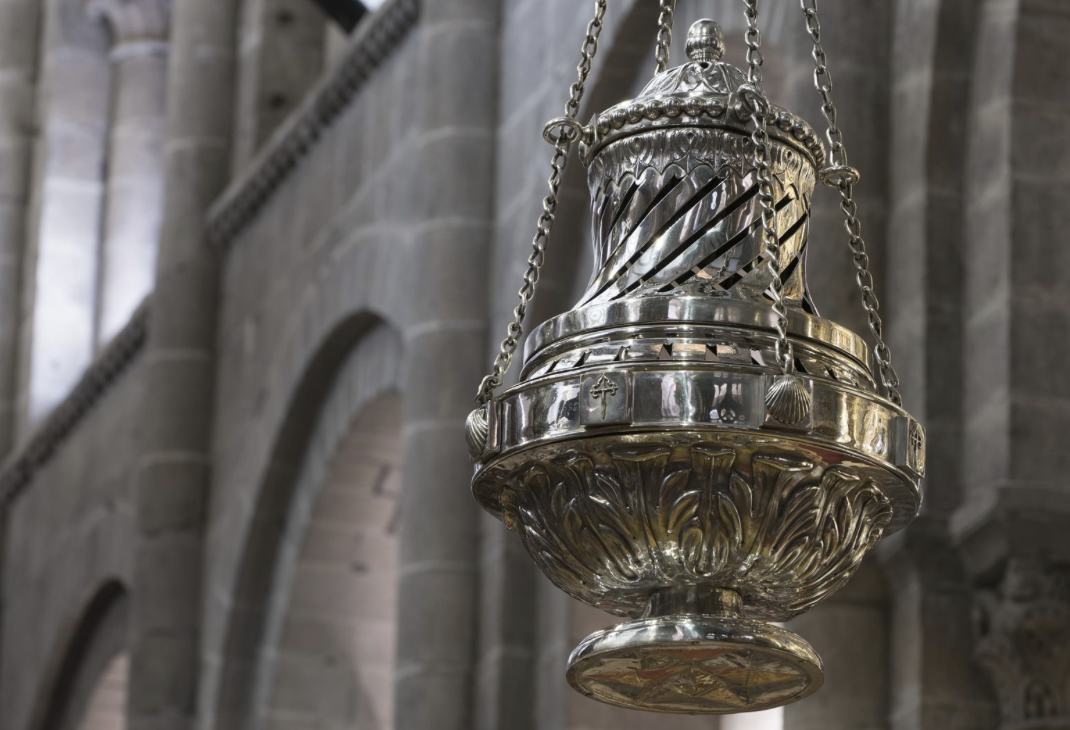
Silver-plated brass, up close, at rest. Even still, you can see why it takes eight men to make this thing fly. Photo credit: catedraldesantiago.es
Where the Ritual Comes From
The tradition goes back centuries. A marginal note in the Codex Calixtinus, one of the oldest written pilgrim guides, mentions a large censer called the Turibulum Magnum as early as the 12th century, tied to major processions and celebrations. The practice likely started for a very practical reason. Pilgrims arriving in Santiago in the Middle Ages sometimes slept inside the cathedral itself after weeks on the road, without much chance to wash. The incense wasn't only symbolic. It helped clear the air.
The current Botafumeiro dates to 1851, a replacement for earlier versions lost or damaged over the centuries. In 2006, it received new silver plating, which added a couple of kilograms to its weight.
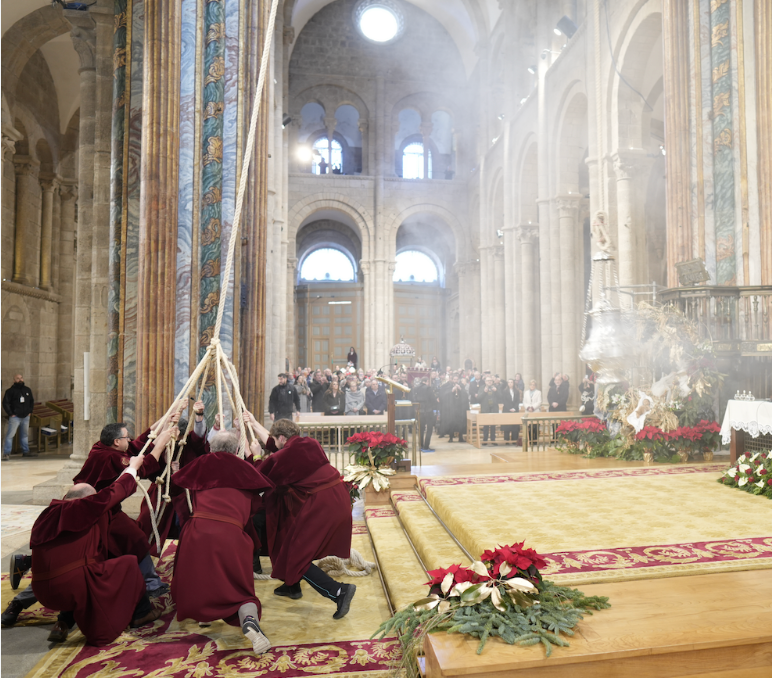
The tiraboleiros pulling the ropes in coordinated bursts, the exact moment that sends the Botafumeiro swinging across the nave. Photo credit: catedraldesantiago.es
The Men Who Make It Fly
Eight men, called tiraboleiros, dressed in red robes, are responsible for setting it in motion. They fill it with incense and hot coal, attach it to the rope system near the altar using strong knots, and pull in coordinated bursts, timed to the lowest point of each swing. It takes real skill and years of practice to get the rhythm right.
The pulley mechanism itself has its own long history, with records of it being adjusted and improved as far back as the 13th century.
The Physics of the Swing
Once the tiraboleiros get it moving, the Botafumeiro builds speed fast. Within about 80 seconds, roughly 17 full swings, it reaches its maximum arc, close to 82 degrees from vertical, tracing a 65-meter path across the transept from one side of the cathedral to the other. At full speed, it's been recorded moving at nearly 70 kilometers per hour, just meters above the heads of the congregation.
When Things Went Wrong
With something this large moving that fast, accidents were probably inevitable. The most famous happened on July 25, 1499, during a Mass held in honor of Princess Catherine of Aragon, who would later become Queen of England. Mid-swing, the rope gave way, and the Botafumeiro flew straight out of the cathedral through a high window near the Platerías door. Remarkably, no one was hurt.
The ropes failed again in 1622, sending it crashing down near the tiraboleiros themselves, and again in 1925 and 1937, the last time spilling hot coal across the floor. Today, it's secured with reinforced sailor's knots specifically designed to prevent a repeat of those failures.
Can You Watch It Swing?
This is the part most pilgrims want to know, and the honest answer is that it depends on timing. Contrary to what many assume, the Botafumeiro isn't swung at every single Mass. It's reserved for specific solemnities, major feast days, the arrival of large pilgrim groups, or Holy Years, when it appears far more often.
If it isn't scheduled during your visit, it can be requested privately for a fee, generally cited somewhere between 300 and 450 euros depending on the source, paid directly to the cathedral in advance. Many pilgrim groups and associations pool funds specifically for this. It's worth checking the cathedral's current schedule before arriving, since the ritual has occasionally paused for maintenance and restoration work in recent years.
Worth the Wait
For a lot of pilgrims, catching the Botafumeiro in motion, the organ playing, incense filling the nave, the huge silver censer swinging almost close enough to touch, becomes the moment the whole Camino settles into place. Whether it happens on the day you arrive or not, it's one more reason Santiago Cathedral has held people's attention for close to a thousand years.
Buen Camino.