Credencial 101: Your Pilgrim Passport, Explained
Before a single kilometer, there is one document every pilgrim needs. It's called the credencial, or the pilgrim passport, and without it, a large part of the Camino simply doesn't work.
The Pilgrim Passport a.k.a Credencial
The credencial has medieval roots. Centuries ago, pilgrims carried a letter of safe conduct, a document that allowed them to travel freely and safely along the route. Today's version is a small, foldable booklet, personal and non-transferable, with space for dozens of stamps collected along the way.
It serves two main purposes. First, it's required to stay in most public and church-run albergues, the budget hostels that make walking the Camino affordable. Second, it's the only accepted proof that you walked the distance, which matters if your goal is to receive the Compostela, the official certificate of pilgrimage, at the end.
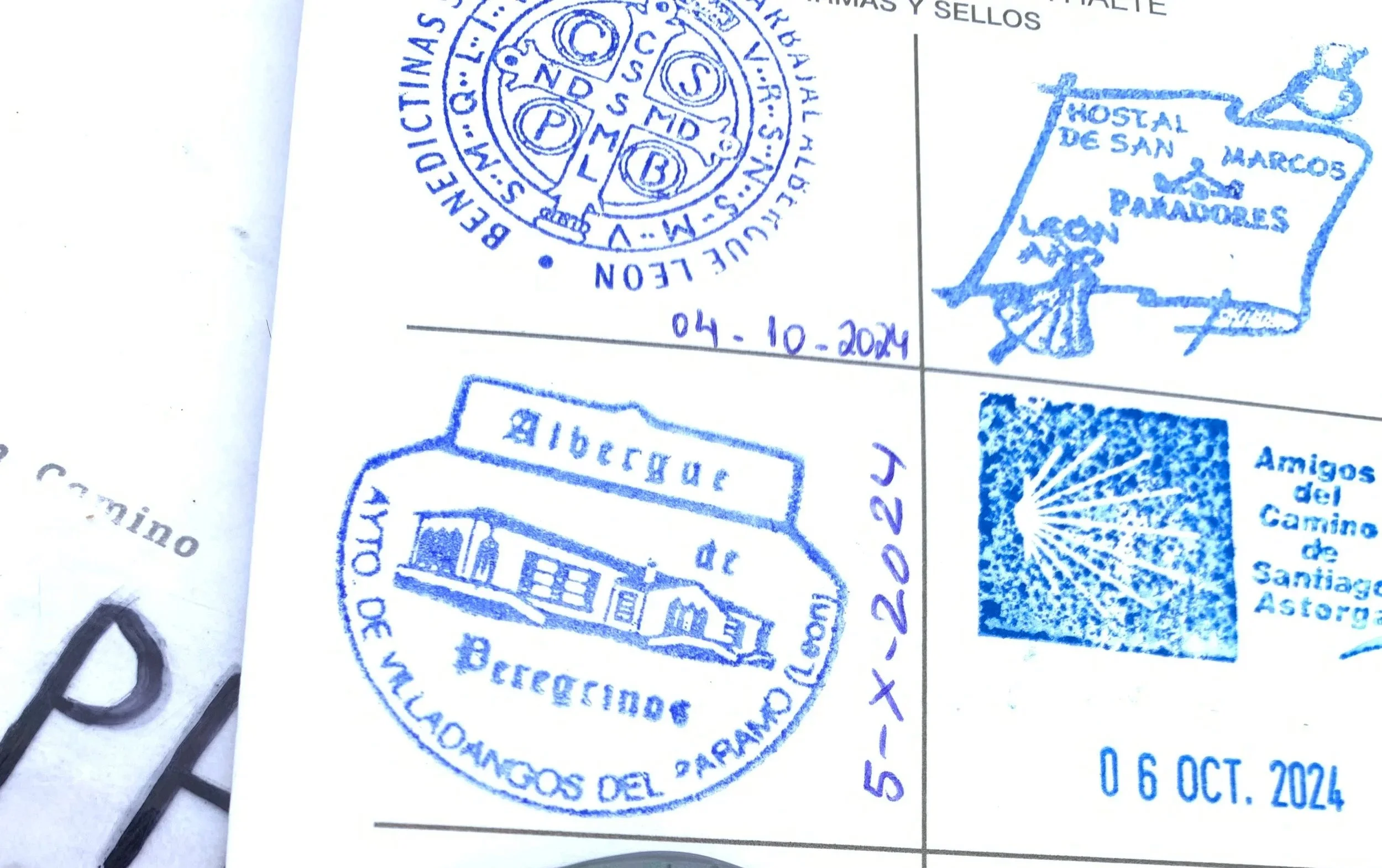
A pilgrim's credencial, stamped at each albergue or hostel along the way, with the date of every stop.
Why Do You Need One
Without a credencial, most albergues will simply turn you away, since it's how they confirm you're a pilgrim and not a regular tourist. It's also your only way to prove distance walked. To receive the Compostela, you need to show at least 100 km walked, or 200 km cycled, into Santiago.
For anyone walking the final stretch from Sarria, this matters even more directly. As covered in an earlier post on that stretch, the last 100 km requires two stamps per day in the credencial, not one, specifically because this is the most common section for people to try to shortcut. Missing stamps here can mean being denied the Compostela at the very end, after walking the whole distance.
Where to Get One Before You Leave
Pilgrims who want a credencial in hand before departure can get one through their national Camino association. In the United States, that's American Pilgrims on the Camino. In Ireland, the Camino Society of Ireland. In Australia, Australian Friends of the Camino. In the United Kingdom, the Confraternity of Saint James. Most of these organizations issue credencials by mail for a small fee or donation, and the process is straightforward if planned a few weeks ahead.
Where to Get One on the Camino Francés
At Saint-Jean-Pied-de-Port, the classic starting point, the Pilgrim's Reception Office on Rue de la Citadelle issues credencials as a matter of course, along with the first stamp of the journey. If the office is closed or missed entirely, pilgrim hostels in town can usually provide one, and if all else fails, it's still possible to get one at the end of the first day's walk, in Roncesvalles.
For pilgrims starting in Sarria specifically, credencials are available at the Iglesia de Santa Mariña and at the Albergue Municipal de Sarria, right at the start of that stretch.
Where to Get One on the Camino Portugués
In Porto, the Cathedral (Sé do Porto) issues credencials during opening hours, generally 9:00 to 17:30. Pilgrims planning an early departure should pick theirs up the evening before, since the cathedral won't be open at typical Camino start times. Some pilgrim-oriented shops and hostels in Porto offer them as well. In Lisbon, credencials are available through local pilgrim associations and some parish churches, though the options are less centralized than in Porto.
Where to Get One on the Camino del Norte
In Irún, the credencial is available daily at the cathedral, at almost any hour, making it one of the more flexible starting points for early risers. If the cathedral is inconvenient, some pilgrims have also picked one up at the local police station as a backup option.
What It Costs
The credencial itself is cheap, usually between 0.50 and 2 euros, and in many pilgrim-run albergues it's offered free, in exchange for a small donation to help maintain the route. It's one of the smallest expenses of the entire trip.
What Happens at the End
Once in Santiago, the stamped credencial gets presented at the Pilgrim's Office (Rúa Carretas 33) to receive the Compostela. Pilgrims can also request a Certificate of Distance for a small additional fee, which states the exact starting point and distance walked, available in several languages. Anyone continuing past Santiago to Fisterra or Muxía can request a separate certificate for that stretch as well.
One Practical Tip
It's tempting to over-prepare and order two or three credencials in advance in case one runs out of space. Running out of room is rare for a single Camino, and if it does happen, an extra credencial is easy to pick up at almost any albergue or church along the way. What's worth planning for is leaving space near the end of the booklet for the final stamp at the cathedral in Santiago, since that's the one stamp every pilgrim needs and the one most people forget to save room for.
Buen Camino.