The Shell Every Pilgrim Wears: Legend, Faith, and the Truth Behind It
Almost every pilgrim on the Camino carries one. Tied to a backpack, painted on a wall, carved into a stone marker. The scallop shell is everywhere on the Way to Santiago. Most people wear one before they actually know why.
The Legend of the Drowning Groom
The most repeated story goes back to the Codex Calixtinus, a 12th-century guide for pilgrims and one of the oldest written records of the Camino. According to the legend, a young groom was riding along the coast during his wedding procession when his horse panicked and threw him into the sea. As Saint James passed by, a miracle occurred. The groom rose from the water alive, his entire body covered in scallop shells. He and the wedding guests converted to Christianity on the spot.
Other versions of the story swap the groom for a knight saved from drowning by Saint James, emerging from the sea in the same way, shells clinging to his body. The details shift depending on who tells it, but the ending is always the same: survival, and a body covered in shells.
The Legend of the Body That Never Should Have Arrived
A separate legend explains not the shell itself, but why Santiago became the destination at all. After Saint James was killed in Jerusalem, his followers are said to have carried his body by boat to the coast of Galicia. When the boat reached the shore, it was found covered in scallop shells, the same species that lived along that stretch of coastline.
This is part of why the shell's scientific name is Pecten Jacobaeus, literally "Jacob's scallop," and why other European languages still carry Saint James's name inside the word for it. In French, it's coquille Saint Jacques. In German, Jakobsmuscheln. The shell and the saint have been linked in language for centuries, regardless of which legend anyone believes.
The Theory That Has Nothing to Do With Saint James
Not every explanation is religious. Some historians point to a much older, pre-Christian layer underneath the Christian story. Long before Santiago was a pilgrimage site, this same stretch of Galician coast, later called the Costa da Morte, was already a place of pagan pilgrimage tied to fertility rituals. Some early travelers are believed to have made the same journey hoping for children or a good harvest, long before Saint James entered the story.
Under this theory, the scallop shell was already a fertility symbol before it became a Christian one. Christianity didn't invent the shell's meaning so much as absorb a symbol that was already there.
None of these explanations cancel each other out. It's entirely possible the shell carries all layers at once: a coastal resource, a pagan symbol, and a Christian legend, stacked on top of each other over centuries.
What the Shape Itself Is Supposed to Mean
Beyond the legends, the shell's physical shape carries its own symbolism. A scallop shell is made of many grooves that all meet at a single point. Pilgrims and clergy came to read this as a metaphor for the Camino itself: many different routes, starting from many different countries and towns, all converging on the same destination, Santiago de Compostela.
For Christians, the shell also came to represent baptism and spiritual rebirth, fitting for a journey many pilgrims describe as transformative.
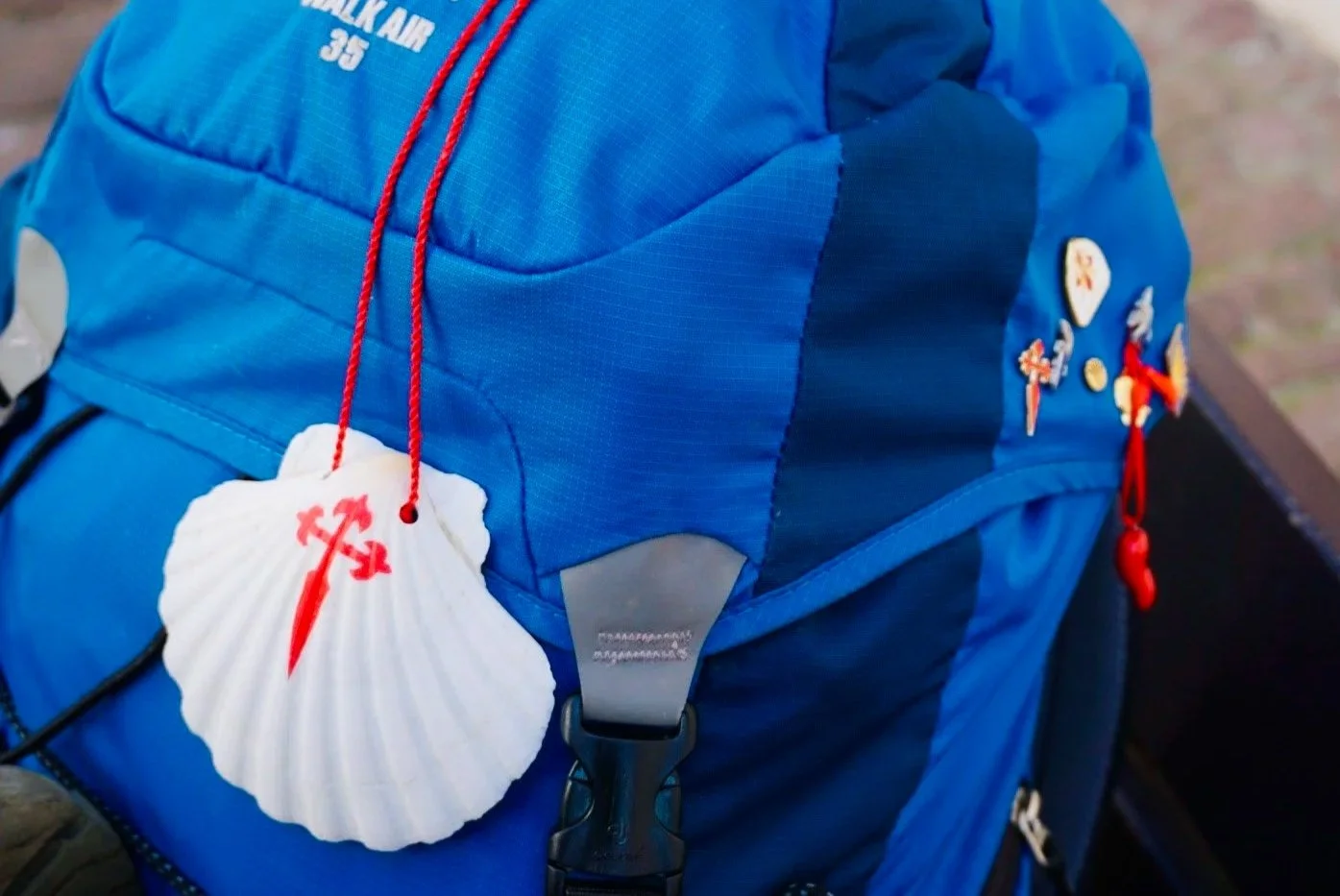
This is the Coquille Saint-Jacques, the shell every pilgrim recognizes. Next to it, a few pins, the small badges pilgrims collect and clip onto their backpacks along the way.
From Sacred Symbol to Everyday Tool
Whatever pilgrims believed about its origin, the shell had a very practical use on the road. Its curved shape made it a natural cup, used to scoop water from streams or wine from a fountain along the way. Some pilgrims also used it as a small bowl to receive food or alms from villagers, since begging for food was a real part of the medieval pilgrimage experience for many walkers.
It also served as proof. Historical records show vendors in Santiago selling scallop shells to arriving pilgrims as early as the 12th century, and clergy at the cathedral would give them out as a kind of certificate, evidence that someone had actually completed the walk. Pilgrims wore them visibly on cloaks or hats for the rest of their journey home, partly as a badge of honor, partly so other travelers along the way would recognize them.
Getting Your Own
Because scallop shells can now be bought online or at almost any souvenir shop near the cathedral, wearing one no longer proves anything about whether someone actually walked. That hasn't stopped the tradition from mattering to the people who carry one.
Many pilgrims choose to pick up a real, unshaped shell along the Galician coast, often in Fisterra, the traditional end point of the Camino for those who continue past Santiago to the Atlantic. Others buy a shell early, often at the beginning of their pilgrimage.
Either way works. There is no judging between pilgrims. The shell is about carrying something that ties one pilgrim to every other pilgrim who has ever worn one, across roads that all lead to the same place.
The scallop shell eventually ends up on a wall back home, and it never really stops being part of the story. Sometimes, you'll walk past it and just like that, you're back on the Camino again, remembering how amazing it all was…
Buen Camino.