What Is the Camino de Santiago ?
The Camino de Santiago ("The Way of St. James") is a network of ancient pilgrimage routes that all lead to one place: the Cathedral of Santiago de Compostela, in the northwest corner of Spain. The most popular route, the Camino Francés (French Way), starts across the border in France and stretches roughly 800 km, about 500 miles, through the Pyrenees and across northern Spain to the cathedral doors.
People have been walking it for over a thousand years. And remarkably, more people are walking it today than ever before in its history.
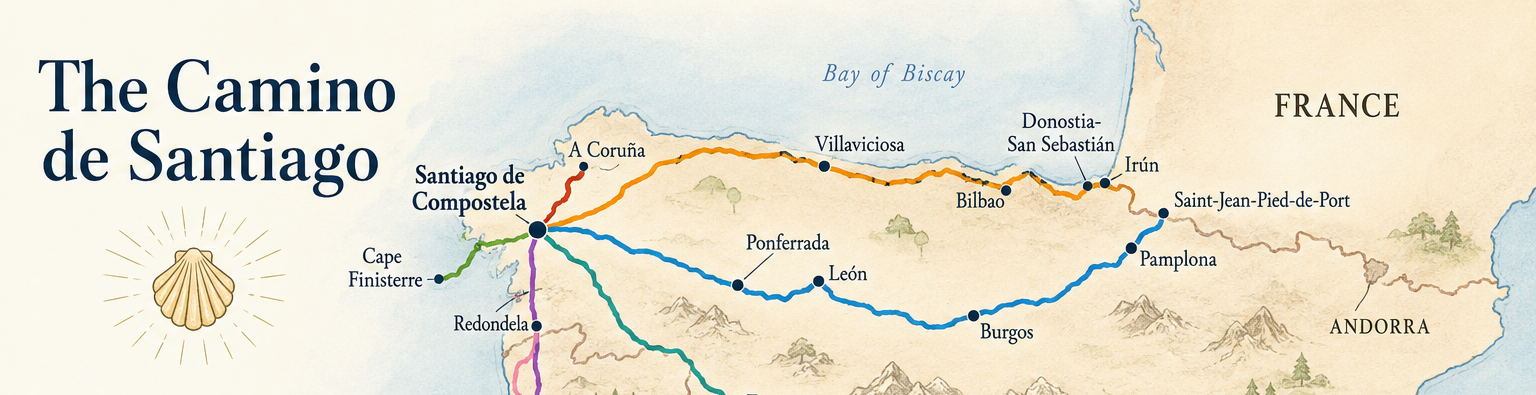
The network of ancient pilgrimage routes leading to Santiago de Compostela, walked by millions for over a thousand years.
Where It All Began
The story starts around the year 813, in Galicia, in northwest Spain. According to medieval legend, a hermit named Paio witnessed a series of strange lights glowing above a hillside over several nights. He reported the visions to the local bishop, who ordered the site investigated, and an ancient tomb was uncovered, believed to hold the remains of the apostle James.
King Alfonso II of Asturias traveled to see the tomb himself, becoming, according to tradition, the very first pilgrim to Compostela. A small chapel was built on the site, eventually replaced by the grand cathedral that still stands there today.
That moment is generally considered the founding story of the Camino de Santiago.
From Medieval Pilgrimage to Global Phenomenon
By the 11th and 12th centuries, Compostela had become one of the three great pilgrimage destinations in Christendom, alongside Rome and Jerusalem. Monks, particularly from the Cluny order, built hospices, bridges, and churches along the way, creating what scholars now describe as a genuine "pilgrimage infrastructure," centuries before the word existed.
The route fell in and out of popularity over the following centuries, but it never fully disappeared. In 1993, UNESCO named the Camino de Santiago a World Heritage Site, a turning point that helped spark its modern revival.
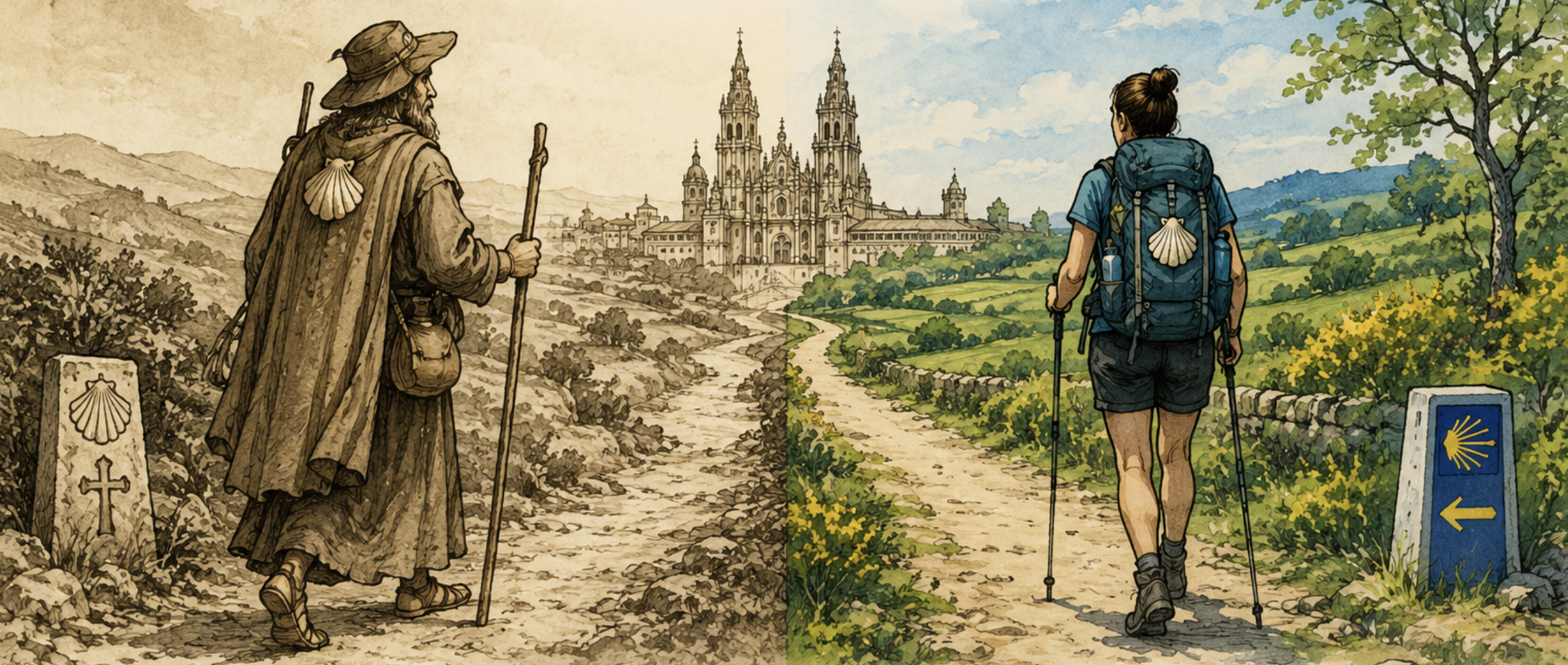
AI-generated illustration of the Camino pilgrim’s journey through time.
Why People Still Walk It Today
Here's the part that might surprise you: this isn't just a historical curiosity. According to the Oficina del Peregrino, the pilgrim's office in Santiago, over 400,000 people officially registered as pilgrims in a recent year alone, and that number keeps climbing.
What's changed is why people walk. The Camino today sits somewhere between religious pilgrimage and personal journey. Some walk for faith. Many walk for something harder to name: a break from a fast-paced, hyper-connected life, a personal transition, or simply the challenge of it. Researchers who study pilgrimage often describe the Camino as a "hybrid" space, where religious tradition and modern, secular self-discovery coexist on the same dusty road. That's part of exactly what makes it so compelling to so many different kinds of people.
That's the space this community lives in too. You don't need to be religious to walk the Camino, and you don't need to have it all figured out before you start. You just need a first step.
What's Next
In future posts, we'll get into the practical stuff: which route to choose, what to pack, how to train, and what nobody tells you about your first week on the trail. But it felt right to start here, with the story of why this path exists at all, and why, more than a thousand years later, people are still walking it.