The Different Ways 2 Santiago
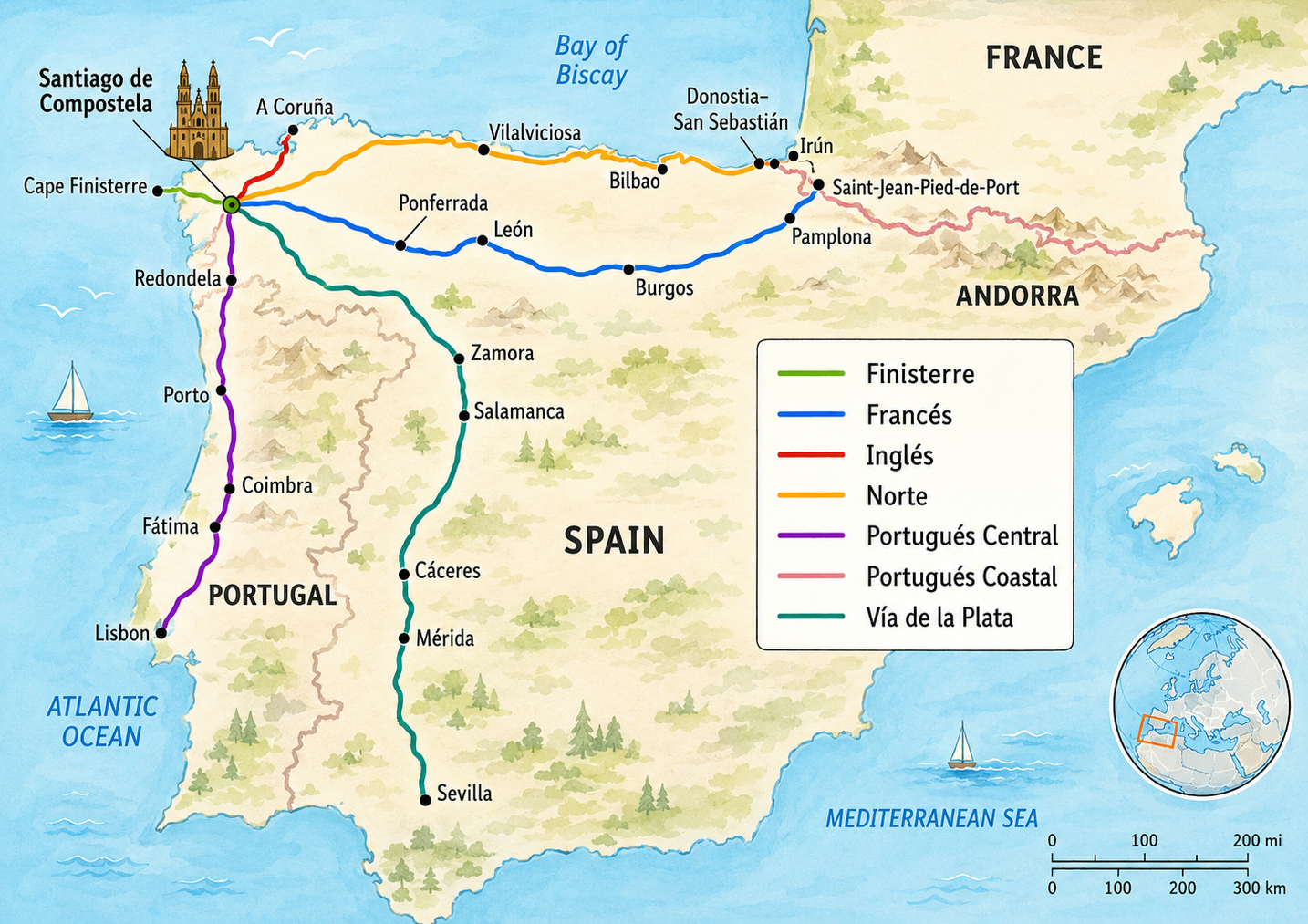
AI-generated illustration of the main Camino de Santiago routes.
Camino Francés - The French Way
Distance: About 800 km, starting in Saint-Jean-Pied-de-Port, France
Duration: Roughly 5 weeks
Vibe: Social, busy, classic
This is the original "famous" Camino, the one from the movies, and it's walked by well over half of all pilgrims. It crosses the Pyrenees into Spain and passes through major cities like Pamplona, Burgos, and León. The infrastructure here is excellent: albergues (pilgrim hostels) are frequent, the path is well marked, and you'll rarely walk more than an hour without passing another pilgrim.
Best for: first-timers who want the classic experience, built-in community, and don't want to worry about logistics.
Camino Portugués - The Portuguese Way
Distance: About 610 km from Lisbon, or roughly 240 km from Porto
Duration: 2 to 4 weeks depending on your starting point
Vibe: Gentler terrain, growing popularity
The second most popular route, and for good reason. Starting from Porto in particular gives you a shorter, more manageable Camino with flatter terrain than the Francés. There's also a coastal variant that runs right along the Atlantic for much of the walk, quieter and especially beautiful if you want ocean views over city stops.
Best for: pilgrims who want fewer crowds and gentler walking, or a shorter time commitment.
Camino del Norte - The Northern Way
Distance: Around 825 km, starting in Irún
Duration: About a month
Vibe: Dramatic coastline, more solitude
This route hugs Spain's northern coast, passing through San Sebastián, Bilbao, and Santander before cutting inland toward the end. It's considered one of the more physically demanding routes because of constant elevation changes, but the coastal scenery is hard to beat.
Best for: pilgrims with some hiking experience who want fewer people and more dramatic landscapes.
Camino Primitivo - The Original Way
Distance: Around 316 km, starting in Oviedo
Duration: About 2 weeks
Vibe: The oldest, and the toughest
This is genuinely the original pilgrimage route, predating even the Francés. It's also widely considered the most physically challenging, with steep mountain climbs through Asturias and long remote stretches with fewer services. It eventually joins the Camino Francés at Melide for the final stretch into Santiago.
Best for: experienced hikers looking for a serious physical challenge and a quieter, more rugged path.
Camino Inglés - The English Way
Distance: About 115 to 120 km, starting in Ferrol
Duration: About a week
Vibe: Short, historic, manageable
Named for the English and Irish pilgrims who historically sailed to Spain's coast before continuing on foot. It's one of the shortest official routes, making it a great option if you're short on time but still want the full pilgrim experience, including the Compostela certificate.
Best for: first-timers with limited time, or anyone easing into their first long walk.
Vía de la Plata - The Silver Route
Distance: About 1,000 km, starting in Seville
Duration: 5 to 7 weeks
Vibe: Remote, historic, solitary
The longest of the traditional Camino routes, and one of the oldest. It follows an ancient Roman road that once connected Mérida to Astorga, and despite the name, "Plata" almost certainly doesn't mean silver at all, it likely comes from the Arabic word for "paved road." This route crosses Spain from south to north through Andalucía, Extremadura, and Castilla y León before joining either the Camino Francés or the Camino Sanabrés toward Galicia. Towns are far apart here, so you'll need to carry more water and food than on other routes, but in exchange you get Roman ruins, medieval cities like Salamanca and Cáceres, and long stretches of genuine quiet.
Best for: experienced long-distance walkers seeking solitude, history, and a true off-the-beaten-path pilgrimage.
Finisterre and Muxía - The Extension
Distance: About 90 km from Santiago
Duration: 3 to 4 days
Vibe: The quiet epilogue
Technically, this one runs in reverse of the others: it starts in Santiago and continues west to the coast, ending at the lighthouse in Fisterra (once believed to be the literal edge of the world) and the fishing village of Muxía. Most pilgrims walk it as an extension after reaching Santiago, not as a standalone Camino. There's no Compostela for this stretch, but there's something quietly perfect about walking until the road simply runs into the ocean.
So, Which One Should You Choose?
Honestly, it depends on what you're looking for:
Want the classic, social experience? Camino Francés.
Want something shorter and gentler? Camino Portugués from Porto, or the Camino Inglés.
Want solitude and coastal views? Camino del Norte.
Want a serious physical challenge? Camino Primitivo.
Already walked to Santiago and want to keep going? Finisterre and Muxía.
There's no wrong choice here. Every route ends in the same place, and every route changes the person who walks it.